
Last updated: September 12, 2026
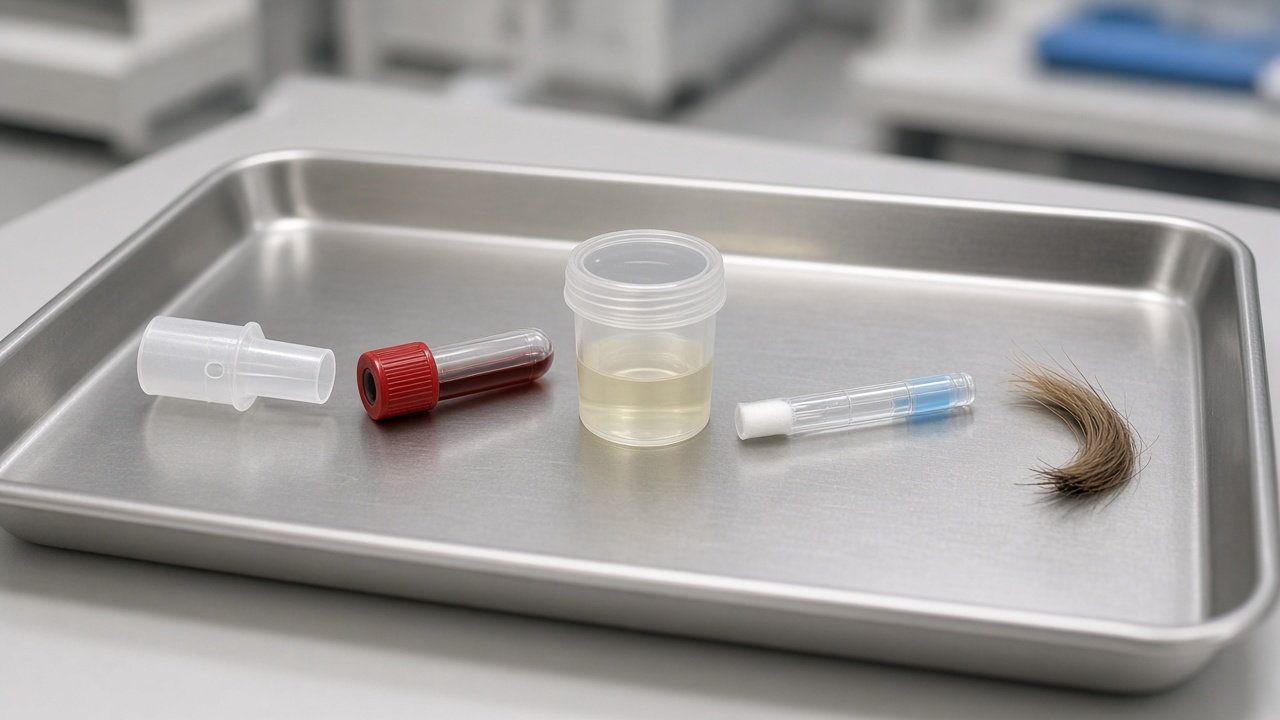
People search how long does alcohol stay in urine and get answers that bounce between 12 hours and 90 days. Those numbers are not arguing about the same test. Ethanol in breath, blood, saliva, and ordinary urine is a hours-scale question. Ethyl glucuronide in urine is a days-scale metabolite. Phosphatidylethanol (PEth) in blood is weeks. Hair EtG and FAEE are months.
This pillar lines those five matrices up with the cutoffs already used on CalcGrain, then sends you to the calculator that matches the sample you actually face. Start with the ETG Detection Time Calculator if the paperwork says urine EtG, or the BAC & Time to Sober Calculator if the question is remaining blood alcohol.
Five detection windows side by side
Ranges below are typical published windows, not a promise for one body. Ethanol windows follow NIAAA metabolism teaching and roadside/clinical practice. EtG cutoffs are the site’s verified 100 / 300 / 500 ng/mL lines. Hair uses SoHT 2019 (≤5 pg/mg vs ≥30 pg/mg on a proximal 3–6 cm scalp segment). PEth uses the site’s 20 / 50 / 200 ng/mL interpretive bands.
| Matrix | What is measured | Typical window | CalcGrain tool |
|---|---|---|---|
| Breath | Ethanol in expired air (proxy for BAC) | Hours, until BAC is near 0.00% | Time to Sober |
| Blood ethanol | Ethanol in venous/capillary blood | Hours (elimination ~0.015%/hr in the teaching model) | BAC legal limit |
| Saliva / oral fluid | Usually ethanol, assay-dependent | Hours, similar order to breath/blood ethanol | Time to Sober (ethanol clock) |
| Urine ethanol | Unchanged alcohol in urine | About 12–24 hours after drinking stops | Not the EtG tools |
| Urine EtG | Ethyl glucuronide vs ng/mL cutoff | Roughly 1–4 days; longer at 100 ng/mL than 500 | EtG calculator / detection time |
| Blood PEth | Phosphatidylethanol in red cells | About 2–4 weeks of recent drinking pattern | PEth calculator |
| Hair | EtG and FAEE/EtPa in the shaft | ~3 months for 3 cm scalp (SoHT); kits often ~1.5 in | Hair follicle calculator |
Why the clocks differ: ethanol vs metabolites
NIAAA describes ethanol as water-soluble, distributed in body water, and eliminated mainly by liver alcohol dehydrogenase at a roughly linear BAC decline after absorption. Breath, blood, and saliva ethanol all wait on that remaining pool. When the pool is gone, those tests go quiet.
Metabolites do not. A small fraction of ethanol is conjugated to glucuronic acid (EtG) or incorporated into red-cell phospholipids (PEth) or trapped in growing hair as EtG/FAEE. Those products can still be measured after parent ethanol is undetectable. That is chemistry, not a longer “hangover.”
Half-life language belongs to the metabolite tools. Urinary EtG on CalcGrain uses a biphasic teaching curve (about 3.5 hours fast, then a slower tail). PEth half-life in the site model is on the order of days, not hours. Hair is not a half-life problem at all — it is a growth-length problem at about 1 cm per month.
Urine alcohol vs EtG urine
Search results mash “how long does alcohol stay in urine” into EtG articles because both use a cup. Labs do not. A urine ethanol (EtOH) result answers whether leftover alcohol is still in that specimen. An EtG result answers whether the metabolite is above the cutoff someone ordered — 100 ng/mL for strict zero-tolerance monitoring, 300 ng/mL as a common clinical/workplace middle, 500 ng/mL as a less sensitive screen.
SAMHSA’s long-standing caution still applies to EtG/EtS: at low concentrations the marker can reflect ethanol exposure, including incidental products, not only beverage drinking. That caution does not apply to a breathalyzer at the roadside in the same way. If your worry is mouthwash or sanitizer at 100 ng/mL, read the dedicated incidental-exposure guide rather than this overview.
For hours-to-clear by drink count at those three cutoffs, use the visual EtG detection time chart and the detection-time calculator.
One drink vs heavier drinking
Ethanol tests scale with remaining BAC: more drinks, higher peak, more hours until 0.00% at about 0.015% per hour after peak in the Widmark-style model used on Time to Sober. Four standard drinks for a 170 lb male over two hours peaks near 0.092% BAC in that model — about six hours after peak to reach 0.00%, plus however long absorption still has to run.
EtG scales with peak metabolite and cutoff. In the same 170 lb male, two-hour session, CalcGrain’s biphasic model estimates roughly 13 hours to clear 100 ng/mL after one drink versus about 40 hours after four drinks. The 500 ng/mL line clears earlier in every row. Those figures are modeled estimates, not a laboratory certificate.
Hair barely notices a single session. SoHT’s ≥30 pg/mg band is framed as chronic excessive drinking across the proximal segment, not one Saturday. PEth sits in between: one binge can contribute, but interpretation is a recent-weeks pattern, with 20 / 50 / 200 ng/mL bands used on the PEth page.
Worked example: four drinks, five matrices
Same person, same sitting: 170 lb male, four NIAAA-standard drinks (14 g ethanol each), two hours of drinking, then no more alcohol.
- Breath / blood / saliva ethanol: peak about 0.092% BAC; teaching elimination 0.015%/hr → near 0.00% about 6 hours after peak. A roadside breathalyzer later that night can still alarm; Monday morning it should not if drinking truly stopped.
- Urine ethanol: typically already uninteresting by the next calendar day.
- Urine EtG: model hours to clear ≈ 40 h (100 ng/mL), 26 h (300), 19 h (500). A 48-hour probation cup at 100 ng/mL is a different story than a 500 ng/mL workplace screen.
- PEth: one evening is not automatically a 200 ng/mL “heavy” band; programs read weeks, not hours. Use the PEth calculator if that is the order.
- Hair: a 3 cm crown cut still represents ~3 months of growth. Four drinks on one night are not the SoHT chronic-excessive interpretation.
If the real question is test-type choice (monitoring vs DUI stop vs employment), see EtG vs breathalyzer vs blood vs hair.
Who these windows actually apply to
Roadside officers and ignition-interlock vendors care about breath ethanol now. Emergency departments drawing a legal blood alcohol care about the same hours-scale pool. Probation and many treatment contracts care about urine EtG because the cup is cheap and the window covers recent days. Transplant and some forensic programs add PEth when they need a weeks-scale systemic marker. Family-court or licensing “90-day” language usually means hair length, not a urine cup.
Personal curiosity after a night out is almost always a BAC question first. Opening an EtG calculator because a search result said “alcohol stays in urine 80 hours” is how people mix matrices. If nobody ordered a metabolite test, the honest tool is Time to Sober plus the reminder that impairment starts below a legal limit.
Employment screens are the wild card. The requisition may say “urine drug screen with EtG,” “ethanol,” or a hair alcohol panel. Read the analyte name. A negative urine ethanol with a positive EtG is a common pattern after drinking has stopped — not a lab contradiction.
False readings and what they are not
Breath devices can be fooled by residual mouth alcohol in the minutes after a drink or some inhalers; waiting protocols exist because of that, not because EtG is involved. Blood ethanol can be drawn at the wrong time relative to absorption. Those are still ethanol-clock problems.
Urine EtG’s distinctive failure mode is incidental ethanol at sensitive cutoffs, plus dilute specimens. Hair’s distinctive failure mode is bleach, dye, and perm chemistry that can crash EtG in the shaft (SoHT plus the bleaching papers cited on the hair guide). PEth’s distinctive limitation is that it does not timestamp Tuesday night; it integrates recent weeks.
None of those failure modes is a method to “beat” a test. They are reasons laboratories document products, treatments, and validity checks.
How to use the calculators without mixing units
Keep units in their families. Urine EtG is ng/mL at 100 / 300 / 500. PEth is also ng/mL but at 20 / 50 / 200 — never copy a urine cutoff onto a blood report. Hair EtG is pg/mg at ≤5 and ≥30 on the SoHT scalp segment. BAC is a percentage (0.08%, 0.05%, 0.00%). Mixing those four scales is the fastest way to write a wrong article — or a wrong self-assessment.
When two CalcGrain pages state a cutoff, they should match this list. If a clinic prints a different line, the clinic’s paperwork wins; the calculators are educational models.
Saliva, breath, and why “system” is the wrong singular
Oral-fluid testing is often sold as convenient. If the assay is ethanol, it is still an hours-scale remaining-pool test, closer to breath than to EtG. Some workplace oral-fluid panels look for other drugs entirely and mention alcohol only as an extra ethanol strip. Read the analyte. A saliva “alcohol” result is not a 90-day hair result and not a 72-hour EtG result.
Breath ethanol is a proxy for BAC, which is why roadside devices and ignition interlocks live in the Time to Sober family. CDC and NIAAA public pages describe impairment and standard drinks; they do not publish a single “alcohol stays in the system X hours” number that covers urine metabolites. That gap in official consumer language is why search results invent one clock.
Heavy drinking changes metabolite windows more than it changes the existence of the ethanol clock. After a binge, BAC still falls at roughly the same percentage per hour in the teaching model; it simply starts higher, so hours-to-zero grow. EtG and PEth, by contrast, accumulate and then decay on their own curves. Hair stores a pattern only if that pattern occupied the proximal centimeters the lab actually digested.
If you need a numeric hours picture for urine EtG, do not average “80 hours” from a forum. Use the drink-count chart and the detection-time calculator, and name the cutoff. If you need months, measure hair length. If you need whether you are still over a driving limit tonight, that is BAC over time on the Time to Sober page — never an EtG bar.
NIAAA’s standard drink (14 g ethanol in the US) is the unit this site’s BAC and EtG models share. A 16 oz craft beer at 7% ABV is not “one beer.” Miscounting drinks is how people think a metabolite window is “wrong.” Count drinks first on the BAC legal limit calculator, then pick the matrix that matches the actual test ordered.
CDC alcohol facts and NIAAA metabolism pages are the public-health backbone for “alcohol leaves the blood at a fairly steady rate.” They do not publish a urine-EtG hours table. SAMHSA’s workplace materials treat EtG/EtS as exposure markers that should not, by themselves, decide a life-altering outcome. SoHT’s 2019 PDF is the hair document. If a number in this pillar is not on that short list, it is labeled as CalcGrain’s educational model (the biphasic EtG hours) or flagged as a clinic-specific cutoff you must read off the requisition.
Unfulfilled on purpose: there is no single peer-reviewed table that states “saliva ethanol always clears at X hours for every donor.” Oral-fluid devices and cutoffs vary. This article therefore describes saliva as hours-scale ethanol, not a forged precision window. If your clinic named a specific ng/mL oral-fluid line, that figure is not confirmed here.
Frequently Asked Questions
How long does alcohol stay in urine?
Unchanged ethanol in urine is typically gone within about a day. Urinary EtG, a metabolite, is a different test and can remain detectable for roughly one to four days depending on drinks, cutoff (100 / 300 / 500 ng/mL), and the lab method. Do not treat “urine” and “EtG urine” as the same clock.
How long does alcohol stay in your system overall?
There is no single clock. Breath and blood ethanol usually clear in hours. Saliva tracks a similar short window. Urine EtG lasts days. PEth in blood lasts weeks. Hair EtG/FAEE on a 3 cm scalp sample looks back about three months (SoHT 2019).
How long is alcohol detectable on a breathalyzer?
A breathalyzer estimates alcohol still in the blood via expired air. Once BAC is near zero, breath ethanol is gone. That is hours after drinking, not days. It cannot answer a probation EtG question.
How long does alcohol stay in blood?
Blood ethanol itself typically falls at about 0.015% BAC per hour after peak in population teaching models (NIAAA-style Widmark elimination). Direct ethanol is a hours-scale test. PEth is a different blood marker with a weeks-scale window.
How long does alcohol stay in saliva?
Oral-fluid ethanol generally tracks recent drinking on a similar order to breath and blood ethanol — hours, not a multi-day metabolite window. Confirm the exact assay your clinic ordered; some panels look for ethanol, not EtG.
Why is EtG urine longer than a urine alcohol test?
Urine ethanol looks for leftover alcohol. EtG looks for ethyl glucuronide, which forms after ethanol exposure and declines more slowly. Mixing the two search phrases is the most common source of 12-hour vs 72-hour confusion.
Does one drink vs heavy drinking change every window?
Yes, magnitude matters most for metabolite tests. A single standard drink may clear a 500 ng/mL EtG line quickly in CalcGrain’s model while 100 ng/mL lasts longer. Hair SoHT ≥30 pg/mg is a chronic-pattern line, not a one-pint trigger.
Which CalcGrain calculator should I use?
Use Time to Sober for BAC hours, EtG Detection Time or the EtG calculator for urine metabolite hours, PEth for weeks in blood, and Hair Follicle for months from sample length. Match the matrix on your paperwork.
Sources
- NIAAA — Alcohol metabolism and standard drink (14 g)
- CDC — Alcohol facts
- SAMHSA — workplace testing context; EtG/EtS as exposure markers, not standalone proof of drinking
- Society of Hair Testing — 2019 consensus on alcohol markers in hair
- CalcGrain Known Verified Figures — urine EtG 100/300/500 ng/mL; PEth 20/50/200 ng/mL; hair EtG ≤5 and ≥30 pg/mg
Match the matrix on the order, then model it: EtG, EtG detection time, time to sober, PEth, or hair follicle. For hour-by-hour BAC decay on the calculator pages themselves, see the “Blood Alcohol Calculator Over Time” sections on Time to Sober and the BAC legal limit tool. Those are refreshes of existing URLs, not a third BAC article.