
Last updated: September 12, 2026
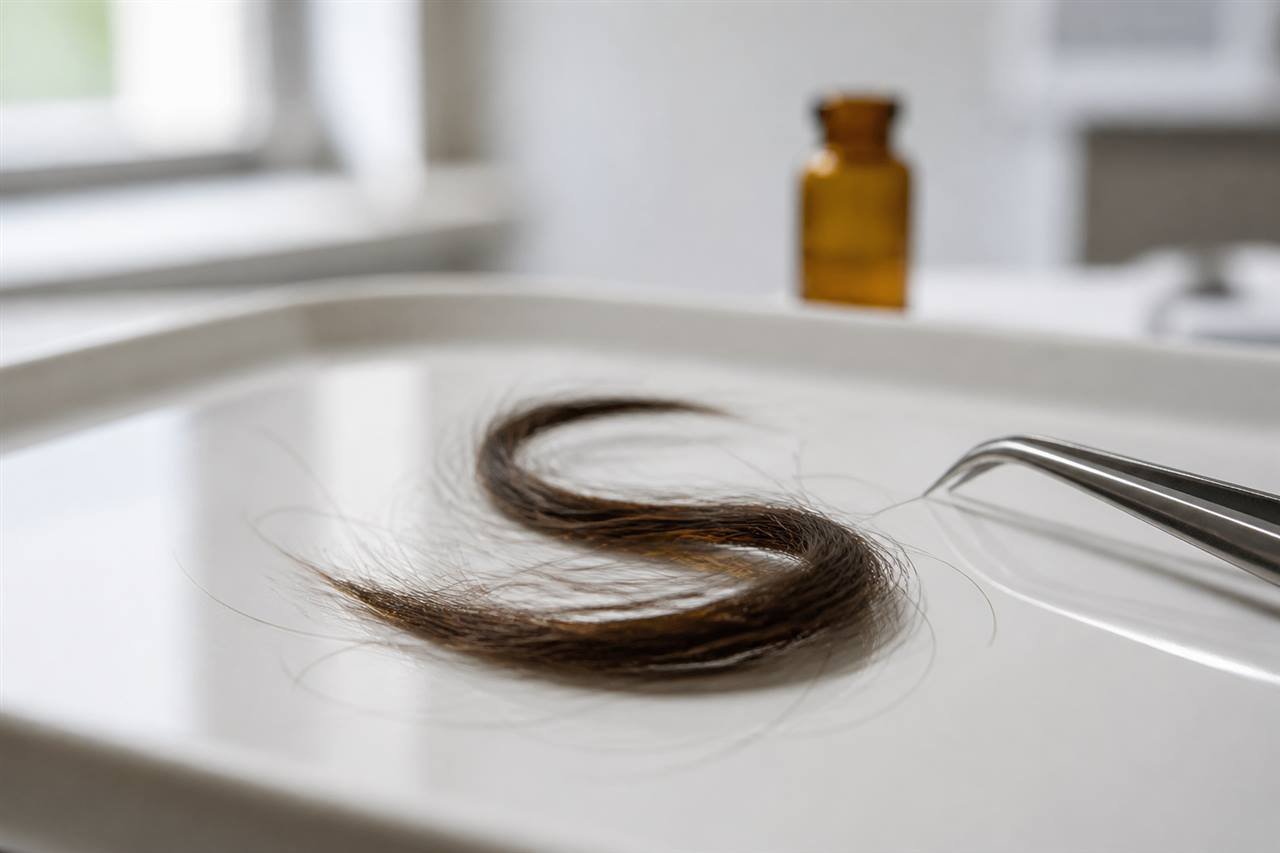
A hair follicle alcohol test is not a breathalyzer in slow motion. Collection teams snip a small bundle of hair — usually from the crown — and a laboratory looks for ethanol metabolites trapped in the shaft as that hair grew. The question people actually need answered is how far back the sample can speak, and which marker the lab is using.
This guide walks through EtG and FAEE in hair (not urine), the months a typical proximal segment represents, and why bleach or a perm can scramble the picture. When you want a length-to-lookback estimate, open the free Hair Follicle Alcohol Test Calculator.
What the test measures: EtG and FAEE in hair
You cannot measure liquid ethanol in hair in a useful way. It evaporates and can also land on the strand from the outside. The Society of Hair Testing (SoHT) therefore points laboratories toward minor metabolites: ethyl glucuronide (EtG) and fatty acid ethyl esters. Newer SoHT language often highlights ethyl palmitate (EtPa) as the FAEE that is reported for interpretation.
Hair EtG is incorporated mainly from the bloodstream at the follicle. FAEE/EtPa is incorporated largely through sebum. That difference matters when someone has bleached or heavily product-treated hair: the two markers do not always move together. Combined interpretation is a SoHT theme for a reason.
NIAAA describes FAEEs as a minor ethanol pathway that also appears in organs such as the liver and pancreas. Hair testing is using that same chemical family as a long-window archive, not as a same-day impairment test.
This is not a urine EtG screen. Urinary EtG can rise and fall over hours to a few days. Hair EtG is a chronic-pattern marker. Mixing the two names is the most common mistake in search results — and in anxious late-night reading.
How far back can it detect drinking?
SoHT’s 2019 consensus treats a proximal scalp segment of 3 cm up to 6 cm as the standard interpretive length. Head hair is modeled at about 1 cm of growth per month, so 3 cm is about three months. That is the scientific backbone of the “about 90 days” idea — not a marketing slogan.
US collection kits often ask for about 1.5 inches of hair. That length is close to 3.8 cm, a little longer than SoHT’s 3 cm baseline. Treat 1.5 inches as a kit convention for a 90-day alcohol test style panel, and treat 3 cm as the published SoHT clock. If the lab cuts a shorter tuft because the donor has a buzz cut, the window shrinks and cutoffs need extra caution — SoHT says so explicitly for samples under 3 cm or over 6 cm.
| Proximal sample | Approximate calendar window | How to read it |
|---|---|---|
| 3 cm scalp (SoHT baseline) | About 3 months | Preferred length for abstinence vs heavy-use cutoffs |
| ~1.5 in (many US kits) | Often described as ~90 days | Slightly longer than 3 cm; confirm what the lab actually analyzed |
| 6 cm scalp | About 6 months | SoHT still publishes cutoffs for this length; extra length is not automatically “more accurate” |
| Body hair | Not the same as scalp months | Different growth cycles; interpret only with the lab’s matrix rules |
SoHT’s published hair-EtG lines (proximal 3–6 cm scalp) include ≤5 pg/mg as not contradicting claimed abstinence, and ≥30 pg/mg as strongly suggesting chronic excessive drinking as SoHT defines it. Those are forensic/clinical consensus numbers, not CalcGrain inventions, and they apply to hair — never to urine ng/mL cutoffs.
False negatives, false positives, and treatments
Cosmetic chemistry is the hair assay’s weak joint. A 2017 Drug Testing and Analysis study found that permanent dyeing and bleaching dropped hair EtG to a median of about 18% of the untreated value in the samples tested. A 2014 Forensic Science International series in alcohol-dependent patients reported mean reductions around 82% after bleaching and 65% after permanent coloring. An in-vitro perm study in the same literature family found mean EtG losses above 90% after waving solution. Those papers describe under-detection (false negatives for drinking), not a guaranteed “pass.”
External ethanol (sprays, some leave-in products) is a bigger worry for FAEE/EtPa than for EtG, which is why SoHT discusses combined reading. Collectors should record recent bleach, dye, keratin, and daily wash frequency. Hiding a history of treatment is a good way to get a confusing report — not a clean one.
Natural hair color is a sideshow next to oxidative damage. Body-site substitution (axillary or pubic hair) is another interpretation trap; SoHT carves those sites out of a simple cutoff copy-paste.
Hair vs urine EtG vs PEth
Pick the matrix that matches the question. Urine EtG answers “was there recent ethanol exposure on a days-long clock?” PEth in blood answers “was there enough systemic drinking over recent weeks to build a red-cell marker?” Hair answers “what pattern lived in this length of shaft?” For a urine-style estimate, use the EtG Alcohol Calculator — it is a different test family. For a weeks-scale blood marker, use the PEth Blood Test Calculator.
Worked example: 1.2 inches vs 1.5 inches
Imagine a donor with 1.2 inches of scalp hair at the crown (about 3.0 cm) and another with 1.5 inches (about 3.8 cm). Using SoHT’s ~1 cm/month model:
- 1.2 in ≈ 3.0 cm ≈ 3.0 months of proximal growth.
- 1.5 in ≈ 3.8 cm ≈ 3.8 months of proximal growth.
The second donor’s kit label may still say “90-day panel,” but the extra millimeters are extra calendar — only if the lab actually digested that full length. If drinking was heavy only in month four and the lab used a 3 cm cut, that month may sit outside the analyzed segment. Enter both lengths in the Hair Follicle Alcohol Test Calculator to see how lookback shifts; do not treat the output as a lab ng/mg or pg/mg prediction.
Frequently Asked Questions
How far back does a hair follicle alcohol test go?
The Society of Hair Testing treats a proximal 3 cm scalp segment as about three months of growth. Many US kits describe a similar span as a 90-day window on roughly 1.5 inches of hair. Shorter samples cover less time and need cautious interpretation.
What does an EtG hair test measure compared with urine EtG?
Hair EtG is locked into the shaft as it grows and reflects months of exposure. Urine EtG is a short-window metabolite that can clear in days. A hair result cannot answer “what did I drink last Tuesday.”
What is a FAEE hair test?
Fatty acid ethyl esters (often summarized as ethyl palmitate in newer SoHT language) form when ethanol meets fatty acids. They enter hair mainly via sebum. Labs may run FAEE/EtPa alongside hair EtG because the two markers do not fail in the same way after cosmetic treatment.
Can bleaching cause a false negative on a hair strand alcohol test?
Peer-reviewed work in Drug Testing and Analysis and Forensic Science International shows bleaching and permanent coloring can cut hair EtG sharply — in some series by more than half, sometimes to undetectable. That underestimates drinking; it is not a reliable way to “beat” a panel.
Will one night of drinking fail a 90 day alcohol test?
Hair markers are built for repeated or heavy patterns across the growth window. A single session is unlikely to mimic the SoHT “chronic excessive” band, but no calculator can promise a negative after any specific party.
Can body hair be used instead of scalp hair?
Some labs accept body hair when scalp hair is too short. Growth cycles differ, so the calendar window is not the same as a 3 cm scalp segment. Ask the collection site which matrix they validated.
Does hair color or melanin change the result?
Natural hair color is a smaller issue than chemical treatment. Oxidative bleaching and perming are the changes toxicology papers flag most often. Collectors should document dyes, bleach, and keratin treatments.
How is this different from a PEth blood test?
PEth sits in red-cell membranes and typically looks back weeks, not months. Hair looks at the length you submit. Use hair for a long pattern question and PEth for a recent-weeks question.
Where should the sample be cut from?
SoHT prefers the posterior vertex (crown) of the scalp, cut close to the skin, with the root end labeled. That keeps the proximal segment aligned with the most recent months.
Can I use CalcGrain instead of a lab?
No. The Hair Follicle Alcohol Test Calculator estimates lookback from length and explains published tiers. Only a laboratory assay of your sample is a test result.
Sources
- Society of Hair Testing — 2019 consensus on alcohol markers in hair
- NIAAA — Alcohol metabolism (including FAEE as a minor pathway)
- Petzel-Witt et al., Drug Testing and Analysis (2018) — bleaching/coloring effects on hair EtG
- Crunelle et al., Forensic Science International (2015) — repeated coloring/bleaching and hair EtG
- Kerekes & Yegles — hair EtG after coloring, bleaching, and perming
A hair follicle alcohol test is a months-scale pattern assay, not a last-call verdict. If you need a lookback from length, start with the Hair Follicle Alcohol Test Calculator. If the real question is last weekend’s urine window, switch to the EtG Alcohol Calculator.