
Last updated: September 12, 2026
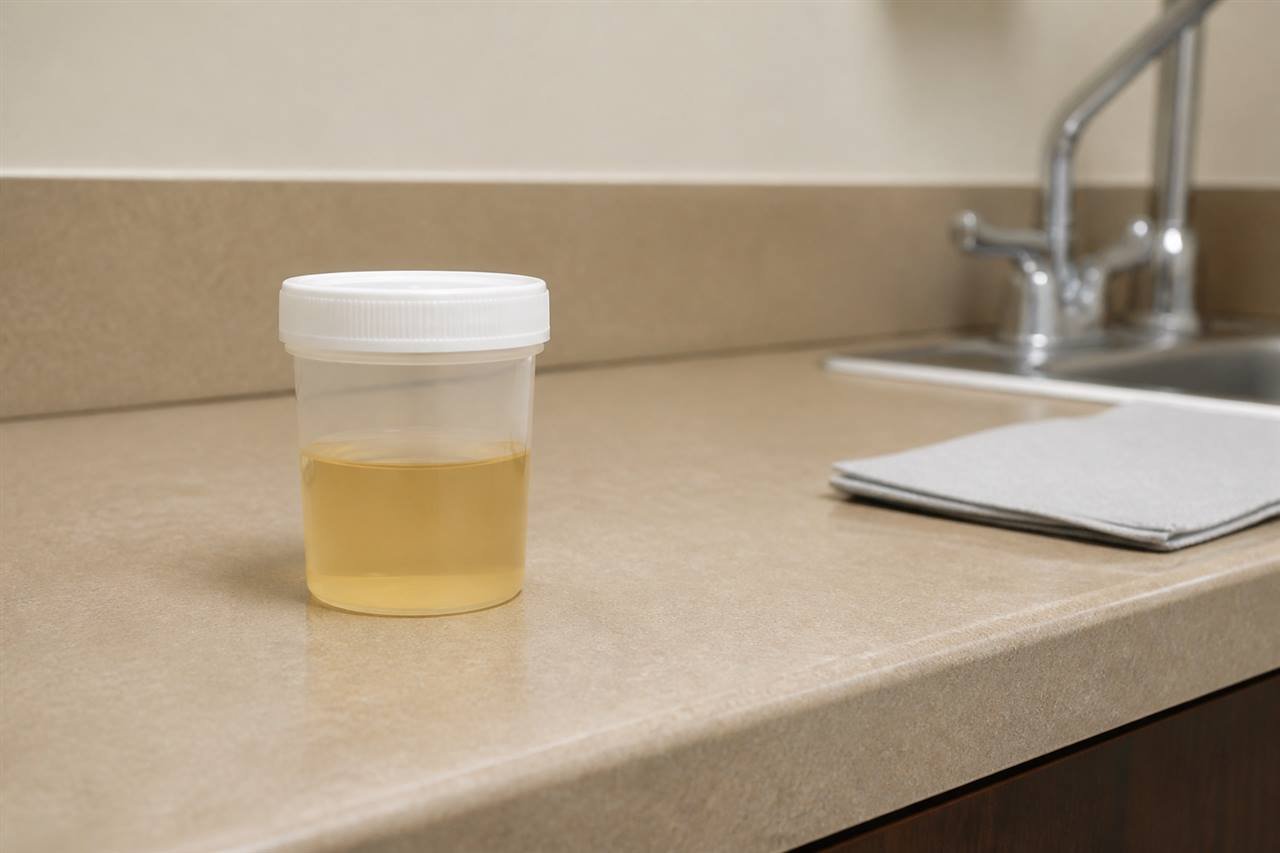
An EtG urine test looks for ethyl glucuronide in a cup of urine — a metabolite your body makes after ethanol exposure — then compares the concentration with a cutoff someone else chose. Collection feels ordinary. Interpretation is not. Cutoff, incidental products, and specimen validity (especially creatinine) decide whether a number becomes a crisis.
This guide covers the procedure, the 100 / 300 / 500 ng/mL family of lines, why mouthwash stories exist, and how a dilute flag works. For a product-by-product incidental-exposure deep dive (mouthwash, sanitizer, cooking, medicines), use Can mouthwash or hand sanitizer cause a false positive EtG? — that page is the exposure layer; this page stays the assay overview. For a urine-framed estimate, use the Alcohol Urine Test Calculator. For the same model with a full cutoff comparison chart, use the EtG Alcohol Calculator.
What happens at collection
A collector checks identity, may observe or use a bluing toilet protocol depending on the program, and sends the specimen with a chain-of-custody form if the context is forensic. The laboratory runs immunoassay screening and, for decisions that matter, confirmatory LC-MS/MS. You will not see “pass/fail” from the mass spec itself — you will see ng/mL versus the cutoff printed on the order.
Temperature, creatinine, specific gravity, and pH are validity checks. They exist because urine is easy to water down. They are not optional trivia.
Cutoff tiers: who uses 100, 300, or 500 ng/mL
| Cutoff | Typical intent | Trade-off |
|---|---|---|
| 100 ng/mL | Strict abstinence monitoring | Longest window; more overlap with incidental exposure studies |
| 300 ng/mL | Common clinical / probation middle | Shorter window than 100; still not “mouthwash-proof” |
| 500 ng/mL | Programs wanting more buffer against incidental ethanol | Shorter positive window after light drinking |
There is no single SAMHSA-mandated EtG cutoff for every clinic. SAMHSA’s advisory language (still cited across clinical toxicology) is that EtG/EtS at low levels cannot reliably separate drinking from other ethanol exposure, and that life-altering decisions should not rest on EtG alone. Some monitoring communities treat values above 500 ng/mL as much more consistent with beverage ethanol in published incidental-exposure work — that is a literature pattern, not a law.
False positives, incidental ethanol, and medications
Mouthwash, alcohol-based sanitizer, and some cosmetics contain ethanol. Clinical papers summarized in Alcoholism: Clinical and Experimental Research (2010) note that intensive mouthwash or hand-gel use can push urinary EtG past 100 ng/mL, while typical incidental studies stay under 500 ng/mL. Costantino and colleagues’ mouthwash work is the study family often quoted for that split.
Cough syrups and nighttime cold liquids can contain enough ethanol to be ordinary drinking from the metabolite’s point of view. NIAAA’s standard-drink math (14 g ethanol) still applies if the label lists alcohol. Those are not “false” positives; they are ethanol the body processed.
Non-alcoholic beer and vanilla extract sit in the same gray zone: small doses, sensitive cutoffs, bad surprises. Disclose products your contract asks about instead of hoping the lab will guess.
Dilute samples and creatinine below 20 mg/dL
The SAMHSA Medical Review Officer manuals used for federal workplace testing require creatinine on every urine and specific gravity when creatinine is under 20.0 mg/dL. A dilute report uses creatinine and specific-gravity bands together (for example creatinine greater than 5 and less than 20 mg/dL with specific gravity in a low band). Monitoring programs copy that logic even when they are not DOT collections.
If you drink a gallon of water to “help EtG,” you may lower the metabolite and earn a dilute flag. Many contracts treat that as a failed screen or a mandatory re-collect. The calculator’s hydration warning exists for that reason.
Worked example: 4 standard drinks, 36 hours, three cutoffs
A 170 lb adult finishes four NIAAA-standard drinks and is tested 36 hours later with normal hydration. In CalcGrain’s biphasic teaching model, light-to-moderate sessions often sit near or under 300 ng/mL in the 24–45 hour band, while 100 ng/mL can still be positive into the 45–72 hour band. Thirty-six hours is therefore a different story at each line:
- 500 ng/mL — frequently already below after a modest session in the model
- 300 ng/mL — close enough that weight, sex, and exact hours matter; run the numbers
- 100 ng/mL — still commonly above after 36 hours in the same sketch
Enter those inputs on the Alcohol Urine Test Calculator rather than memorizing this paragraph. If the hydration toggle is set to highly hydrated, watch the dilute warning — that is a validity problem, not a faster half-life.
Frequently Asked Questions
How does an EtG urine test work?
You provide a urine specimen. The lab screens and, in forensic work, confirms ethyl glucuronide — a metabolite of ethanol — usually by a mass-spectrometry method. The report compares ng/mL to the cutoff your program ordered, not to a universal “fail” number.
What is the difference between 100, 300, and 500 ng/mL?
One hundred is a sensitive abstinence-style line with the longest modeled window. Three hundred is a common clinical/monitoring middle. Five hundred is often chosen where programs want more buffer against incidental ethanol. Match the line on your paperwork.
Can mouthwash cause a false positive EtG urine test?
SAMHSA cautioned that EtG/EtS can reflect exposure, not only beverage drinking, especially at low concentrations. Published mouthwash studies have produced urinary EtG above 100 ng/mL in some volunteers, generally remaining below 500 ng/mL. Intensity and timing of exposure matter.
What about hand sanitizer?
Repeated dermal ethanol can also generate low-level urinary EtG in the literature. That is another reason programs that treat any 100 ng/mL hit as “relapse” are using a harsher rule than SAMHSA’s “do not use EtG alone for life-altering decisions” advice.
What is a dilute EtG sample?
HHS/SAMHSA workplace validity rules use creatinine under 20 mg/dL (with specified specific-gravity ranges) to call a urine dilute. Dilute urine can pull any dissolved marker down and may be treated as a failed or re-collect event even when the drug/alcohol analyte is below cutoff.
Do cough syrups or Nyquil show up?
Ethanol-containing medicines are beverage-equivalent ethanol if the dose is large enough. They are not “incidental” in the mouthwash sense. Read labels; a monitoring contract often bans them without a prescriber note.
Is EtG the same as a urine ethanol (EtOH) test?
Urine ethanol looks for leftover alcohol itself and has a short window. EtG looks for a metabolite and lasts longer. A negative urine ethanol with a positive EtG is a common pattern after drinking has stopped.
How should I prepare on collection day?
Follow the collector’s instructions. Do not over-hydrate to “help” the number. Bring a list of medications and alcohol-containing products if the program asks. Normal hydration and an honest cutoff selection beat last-minute water loading.
Can CalcGrain tell me if I will pass?
No. The Alcohol Urine Test Calculator estimates ng/mL versus common cutoffs using the same educational model as the main EtG tool. Only the laboratory result counts.
Should I also look at PEth or hair?
Those answer different clocks (weeks in blood, months in hair). Use them when the program ordered them — not as a substitute for understanding the urine panel you actually face.
Sources
- SAMHSA — MRO Guidance Manual (dilute urine / creatinine)
- SAMHSA advisory on biomarkers / EtG-EtS as supportive tests (incidental exposure caution)
- NIAAA — Standard drink (14 g ethanol)
- Jatlow & O’Malley, Alcoholism: Clinical and Experimental Research (2010) — clinical use of EtG and incidental exposure
- Costantino et al. mouthwash exposure study (commonly cited for sub-500 ng/mL incidental EtG)
Walk into an EtG urine test knowing the cutoff, the validity rules, and the incidental-exposure caveat — not a rumor. Model a urine scenario on the Alcohol Urine Test Calculator. Compare all three cutoffs on the EtG Alcohol Calculator.