
Last updated: September 12, 2026
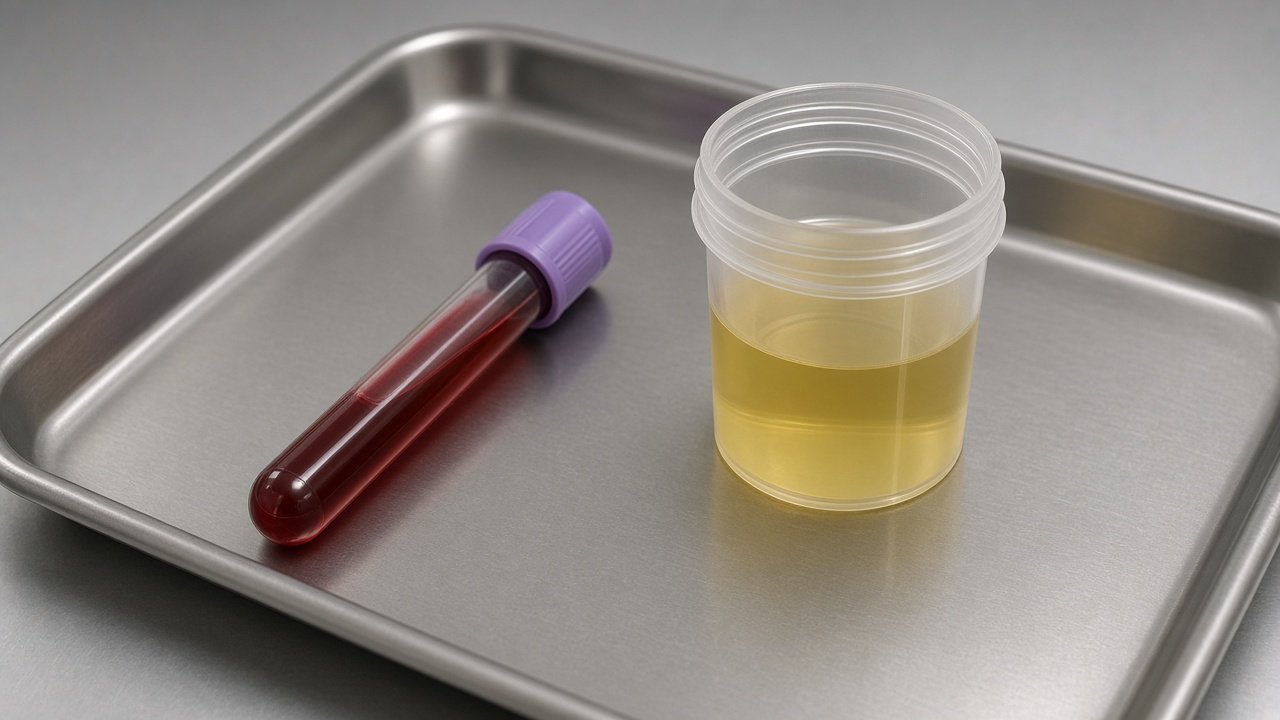
PEth vs EtG is the comparison CalcGrain was missing: strong pages on each test, no head-to-head. Use this hub to pick a matrix, then open the matching calculator — EtG Alcohol Calculator, ETG Detection Time, or PEth Blood Test Calculator.
Hair is a third clock (~3 months, SoHT). It is not a tie-breaker between these two; it is a different question. See the hair follicle guide.
What each marker actually is
Ethyl glucuronide is a small, water-soluble metabolite. In urine it can appear after beverage ethanol or, at low concentrations, after other ethanol exposure — the reason SAMHSA warned not to treat EtG/EtS alone as a life-altering proof of drinking.
Phosphatidylethanol forms in red-cell membranes when ethanol, phosphatidylcholine, and phospholipase D meet. That path needs ethanol in blood. It is why PEth is used when a program wants a weeks-scale systemic marker rather than a days-scale urine one.
Side-by-side cutoffs and windows
| Urine EtG | Blood PEth | |
|---|---|---|
| Typical question | Recent days of exposure | Recent weeks of drinking pattern |
| CalcGrain cutoffs | 100 / 300 / 500 ng/mL | 20 / 50 / 200 ng/mL |
| Strict line | 100 ng/mL zero-tolerance monitoring | 20 ng/mL commonly discussed as above light/abstinence-style bands |
| Heavier band | Not a “chronic” hair line — still days | ≥200 ng/mL heavy/chronic consumption band on the PEth page |
| Incidental mouthwash/sanitizer | Documented issue especially near 100 ng/mL | Not the classic false-positive story |
Monitoring programs and contested results
Programs often start with urine EtG because collection is familiar and the window matches “did you drink this week?” If a 100 ng/mL result is fought as mouthwash or sanitizer, some clinicians add PEth rather than arguing about a number that SAMHSA already said is a poor standalone verdict at low level.
That is not advice to shop tests. It is why the two calculators exist on the same site: so the windows are not mashed into one folklore “alcohol test.”
Worked example: fail one, pass the other
Case A — recent cup, quiet month: four drinks 36 hours ago. Urine EtG at 100 ng/mL is still often modeled positive (~40 hours to clear in the 170 lb male sketch). PEth from a previously light month may sit under 20 ng/mL. EtG “fail,” PEth “low” is a days-vs-weeks mismatch.
Case B — dry week, heavy prior month: urine EtG below 500 ng/mL after many dry days, while PEth is still in the 50–200 ng/mL neighborhood as red cells turn over. EtG “pass,” PEth “elevated.”
Neither case is a method to game a program. Both are reasons to read the order before panicking at a forum anecdote. Full PEth band language: PEth cutoff levels explained. EtG hours picture: EtG detection time chart.
Which one is “more accurate”?
Laboratories can run either assay well. Accuracy here means whether the marker matches the question. EtG is the better days-scale urine marker and the worse incidental-exposure story at 100 ng/mL. PEth is the better weeks-scale blood marker and a poor tool for “did I drink last night after a month of abstinence?” if the draw is too soon for red-cell incorporation to tell a simple story — and a poor tool for “was I impaired at 11 p.m.?” which is still BAC.
Hair sits outside the contest. SoHT’s 3 cm / 3 month frame will not referee a Wednesday EtG. Use hair when the order is hair.
Cost and logistics also differ: urine is easier to collect repeatedly; blood PEth needs a venipuncture; hair needs a labeled proximal cut. Programs pick based on that, not on internet rankings.
Units you must not swap
EtG urine: 100, 300, 500 ng/mL. PEth blood: 20, 50, 200 ng/mL. Hair EtG: ≤5 pg/mg and ≥30 pg/mg. If a message board quotes “500” without a matrix, ask which test. Five hundred ng/mL urine EtG is a less sensitive screen. Five hundred as a PEth number is not a CalcGrain band. Mixing them is the error this hub exists to stop.
When a program orders both
Ordering both is not indecision. Urine EtG answers a short clock that is cheap to repeat. PEth answers whether there was enough systemic ethanol over recent weeks to build a red-cell marker. Together they reduce the “must have been mouthwash” argument at 100 ng/mL because PEth is not the classic incidental-exposure assay. Together they also catch the dry-week-after-a-heavy-month pattern that urine alone would miss.
That pairing is still not a breathalyzer and not a hair test. If the paperwork says all three, you have three questions. Model each on its own calculator. Do not average the cutoffs.
Clinicians sometimes treat PEth ≥200 ng/mL as the heavy/chronic band on the same scale CalcGrain publishes, and treat EtG primarily as a recent-days screen. Crossing those interpretive habits — calling a 200 ng/mL EtG “chronic” or a 500 ng/mL PEth “workplace screen” — is how adjacent numbers get swapped. Pin the matrix before you pin the integer.
What this comparison is not
It is not advice to pick the test you are more likely to “pass.” Programs choose the draw. It is not a claim that PEth is immune to all interpretation disputes; half-life, hematocrit, and timing still matter, which is why the PEth calculator exists. It is not a claim that EtG is useless; it is the right tool for many recent-days questions when the cutoff is named and confirmation is done.
For product-level EtG false-positive mechanics, use the incidental-exposure article. For hour bars by drink count, use the EtG detection time chart. For months, use hair. This page’s job is the vs query that ties the two calculator clusters together.
Half-life language also differs. Urinary EtG is discussed in hours (fast then slow tail on this site). PEth is discussed in days (CalcGrain’s PEth tool defaults near a 7-day teaching half-life with a published 4–10 day literature band). You cannot convert a 40-hour EtG bar into a PEth ng/mL by scaling. Run each model on its own inputs.
Confirmation still matters. An immunoassay screen is not a mass-spec concentration. Forums quoting a “failed EtG” without a cutoff and without confirmation are not comparable to a PEth 20 / 50 / 200 ng/mL report. Ask for the analyte, the matrix, the cutoff, and whether LC-MS/MS confirmed the number before you compare the two tests at all. Then open only the calculator that matches that paperwork.
Frequently Asked Questions
What is the difference between PEth and EtG?
EtG is usually measured in urine and reflects recent days of ethanol exposure against 100/300/500 ng/mL cutoffs. PEth is measured in blood and reflects recent weeks of systemic drinking against 20/50/200 ng/mL bands used on CalcGrain.
Which is more accurate, PEth or EtG?
They measure different things. PEth forms in red cells when ethanol is in blood; incidental mouthwash is a classic EtG headache, not a PEth one. Accuracy means “right matrix for the window,” not a winner.
Can I fail EtG and pass PEth?
Yes. A recent drink can raise urine EtG while PEth, which integrates weeks, stays in a lower band — or the reverse after several dry days following a heavy month. Different clocks, not a cheat code.
Can I fail PEth and pass EtG?
Also yes. After enough dry days, urine EtG can be below cutoff while PEth is still clearing through 20–200 ng/mL territory from earlier weeks.
Which test do probation programs prefer?
Many start with urine EtG because it is cheaper and captures recent days. Some add PEth when a low-level EtG is disputed or when they want a weeks-scale view. Hair is the months-scale option. Read the contract.
What PEth cutoffs does CalcGrain use?
The published PEth cutoff article and calculator use 20 ng/mL, 50 ng/mL, and 200 ng/mL interpretive bands. Do not mix those ng/mL numbers with urine EtG 100/300/500 or hair pg/mg.
Does hand sanitizer affect PEth?
PEth needs ethanol in blood at a scale incidental skin or mouth ethanol does not usually reach. That is the mechanical contrast with sensitive urine EtG at 100 ng/mL.
Which calculator should I use?
EtG calculator or detection time for a cup. PEth calculator for a blood marker. Hair follicle if the order is a shaft sample.
Sources
- SAMHSA — workplace testing; EtG/EtS as supportive exposure markers
- CalcGrain — PEth 20 / 50 / 200 ng/mL and urine EtG 100 / 300 / 500 ng/mL
- SoHT 2019 hair consensus — third matrix, not a PEth/EtG referee
Open the tool that matches the draw: EtG or PEth.