
Last updated: September 12, 2026
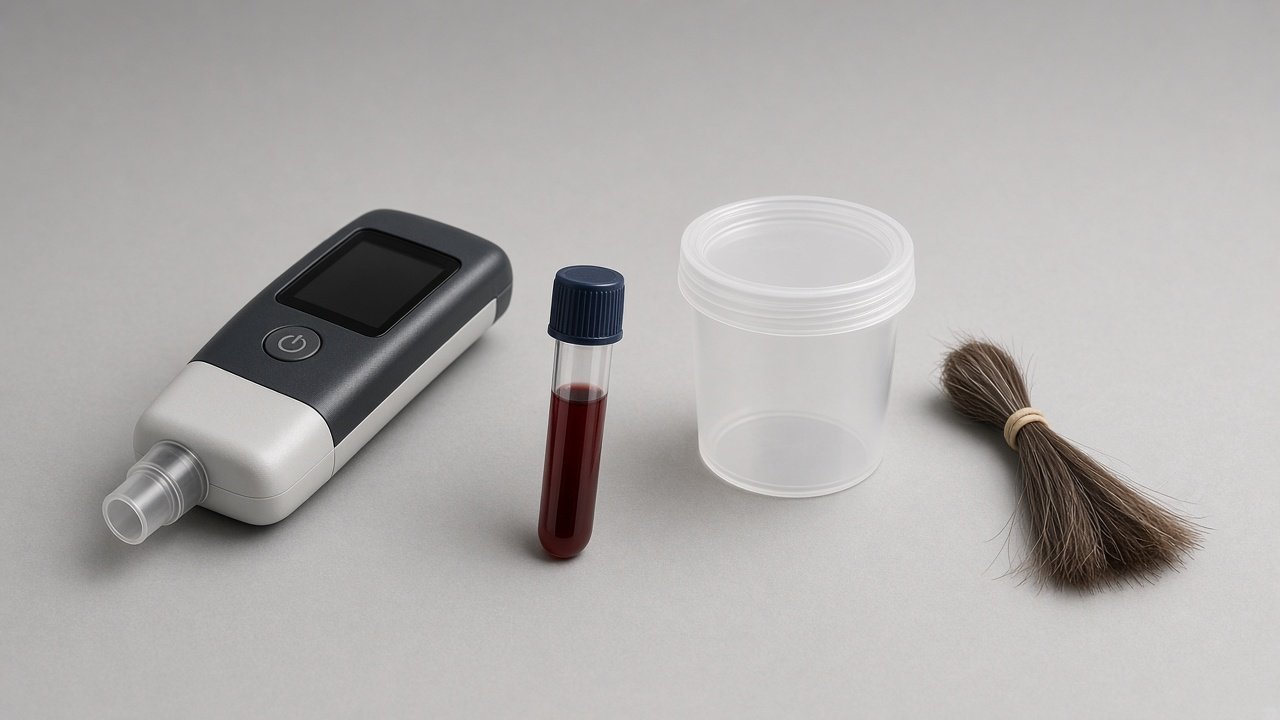
EtG vs breathalyzer vs blood vs hair is not a ranking of “best test.” It is four clocks. A DUI stop, a probation cup, an employment screen, and personal curiosity do not share a matrix. Pick the sample that answers the question you actually have.
For a master window table, see how long alcohol stays in your system. Tools: EtG, time to sober, BAC legal limit, PEth, hair follicle.
Decision framework by situation
| Situation | Relevant test | Why |
|---|---|---|
| Roadside / DUI stop | Breathalyzer; sometimes blood ethanol | Impairment and legal BAC now — hours, not metabolites |
| Probation / abstinence monitoring | Usually urine EtG (cutoff on the order); sometimes PEth or hair | Days-scale exposure; programs may stack matrices when a result is contested |
| Employment / clinical screening | Varies: urine ethanol, EtG, or a hair panel | Read the panel name. “Urine drug screen with EtG” is not a 90-day hair test |
| Personal curiosity after a night out | BAC / time to sober first; EtG only if you face that cup | Curiosity about driving risk is a BAC problem; curiosity about a Monday test is an EtG problem |
What each test actually detects
Breathalyzer. Ethanol in expired air as a proxy for BAC. Window: until BAC is near zero. NHTSA and state implied-consent rules govern devices at the curb; they do not measure EtG.
Blood alcohol (ethanol). Direct ethanol concentration. Same hours-scale family as breath. Hospital trauma panels and many DUI blood draws live here. Do not confuse with PEth.
Urine EtG. Ethyl glucuronide vs 100 / 300 / 500 ng/mL. Days, not hours. SAMHSA cautions that low-level EtG/EtS can reflect exposure other than drinking. Details: EtG urine test overview.
Hair follicle. EtG and FAEE in the shaft. SoHT 2019: 3 cm ≈ 3 months; ≤5 pg/mg does not contradict claimed abstinence; ≥30 pg/mg strongly suggests chronic excessive drinking as SoHT defines it. Calculator: hair lookback from length.
The detection-span picture is the same relative scale as the pillar guide (hours → days → weeks → months). Use that article’s chart rather than duplicating a second set of invented lengths.
Worked example: Sunday night, Monday morning
Four standard drinks Sunday 8–10 p.m., 170 lb male. Monday 8 a.m. is 10 hours after peak in a simple sketch.
- Breath/blood ethanol: still possibly above 0.00% (peak ~0.092%, ~6 hours to zero after peak) — a morning commute is not “proven sober” from the party math alone if peak was late.
- Urine EtG: still modeled above 100 ng/mL (≈40 hours to clear in the four-drink row) and likely above 300 ng/mL (≈26 hours).
- Hair: unchanged. One Sunday is not a 3-month pattern.
Same person, three weeks later with no more drinking: breath is irrelevant; EtG urine should be long clear; PEth may still be falling through the 20–50 ng/mL neighborhood depending on starting level; hair still holds the month that contained that Sunday if that centimeter is in the proximal cut.
Employment screens vs curiosity vs court
An employer panel is whatever the vendor coded. Some occupational health clinics still run urine ethanol with a short window. Others add EtG because they want days, not hours. A pre-employment hair alcohol test is a pattern screen; treating it like a Monday breathalyzer is a category error.
Family court and professional-licensing monitors often stack matrices when a result will change custody or a license. That is why this site keeps EtG, PEth, and hair as separate calculators. Stacking is a program choice, not a way to shop for the friendliest number.
Curiosity (“could a cop still smell it?”) is breath and BAC. Curiosity (“will HR’s cup still see Saturday?”) is EtG. Curiosity (“will a 90-day hair kit see last month?”) is hair length. If you catch yourself asking all three as one question, split them.
Blood ethanol is not PEth
Search language says “blood alcohol test” for both a hospital ethanol draw and a PEth send-out. The first is hours and pairs with a breathalyzer. The second is weeks and pairs with monitoring. CalcGrain’s BAC legal-limit tool is the first family. The PEth calculator is the second. Putting them in one sentence without naming the analyte is how forums invent 14-day breathalyzer myths.
Head-to-head metabolite detail: PEth vs EtG. Incidental products that bother EtG more than PEth: mouthwash and sanitizer.
Probation monitoring in practice
A typical abstinence contract names a matrix and a cutoff, not “an alcohol test.” Urine EtG at 100 ng/mL is a zero-tolerance style line with the longest modeled urine window and the most incidental-exposure overlap. Urine EtG at 500 ng/mL is a shorter window with more buffer against mouthwash-level literature values — and still fully capable of catching beverage ethanol. Some contracts add random timing so a 48-hour folklore window is not a plan.
When a low urine number is disputed, the next draw is often PEth or a repeat EtG, not a breathalyzer. Breath would already be negative if days have passed. Hair is added when the dispute is about months of pattern, not about last Thursday.
Employment occupational-health vendors may still run immunoassay screens with confirmation by LC-MS/MS. A non-negative immunoassay is not the same as a confirmed ng/mL above cutoff. CalcGrain models confirmed-style concentrations for education; they are not a point-of-care cup.
Personal curiosity without a court order
If nobody ordered a test, the useful question is usually remaining BAC and whether you should drive — answer: you should not drive after drinking, regardless of a model. Time to Sober and the legal-limit calculator exist to teach the slope, not to clear a commute.
Curiosity about “will it show on a life-insurance exam next month?” depends on whether that exam is serum ethanol, PEth, or something else. Ask the examiner which analyte. Defaulting to EtG urine folklore is how people prepare for the wrong clock.
The comparison table at the top of this page is the decision framework the playbook asked for: situation first, matrix second. The pillar guide keeps the master window chart so this page does not invent a second set of hour counts.
Saliva ethanol, where used, sits with breath and blood ethanol on an hours clock. It is not EtG and not hair. If a workplace uses an oral-fluid ethanol screen, treat it as recent drinking, not as a 72-hour urine metabolite. CalcGrain’s saliva mention on the pillar guide is the window table; this page’s job is the four named tools people actually compare in search: EtG, breathalyzer, blood, hair — with PEth named whenever “blood” would otherwise be ambiguous.
Legal BAC limits (0.08% for many US adult drivers; 0.04% CDL; 0.02% or other zero-tolerance under 21 in many states) belong to the breath/blood ethanol family. They do not translate into 100 ng/mL EtG. Mixing a DUI statute with a probation cutoff is the error this comparison exists to stop. Use the BAC legal limit calculator for the statute line and the EtG tools for the cup. If the order is hair, skip both and use length on the hair calculator.
Frequently Asked Questions
What is the difference between EtG and a breathalyzer?
A breathalyzer estimates alcohol still in blood right now (hours). EtG is a urine metabolite that can remain detectable for days after ethanol is gone. They answer different questions and are not interchangeable for probation vs a traffic stop.
EtG vs blood alcohol test — which lasts longer?
Direct blood ethanol lasts hours, like breath. PEth is a different blood test (weeks, 20/50/200 ng/mL bands on this site). Plain “blood alcohol” in a hospital or DUI draw is usually ethanol, not PEth.
When is a hair follicle alcohol test the right tool?
When the question is months of pattern, not last weekend. SoHT’s 3 cm scalp segment is about three months. It will not confirm a single session the way a breathalyzer can.
Which test is used at a DUI stop?
Breath (and sometimes blood ethanol), plus field sobriety. Urine EtG and hair are not roadside impairment tests. Legal BAC limits are a Time to Sober / legal-limit calculator question.
Which test do monitoring programs use?
Often urine EtG/EtS at a printed cutoff, sometimes with PEth if a low urine result is disputed, sometimes hair for a longer lookback. Read the order; do not assume.
Can I fail EtG and pass a breathalyzer the same day?
Yes, because the clocks differ. Breath can be 0.00% while urinary EtG is still above 100 ng/mL. That is expected chemistry, not a lab error by itself.
Is PEth more accurate than EtG?
Accuracy is the wrong word. PEth is harder to explain with mouthwash-level exposure and looks at weeks. EtG is better at recent days. See CalcGrain’s dedicated PEth vs EtG comparison for cutoffs side by side.
Which calculator should I open?
Breath/BAC: Time to Sober or BAC legal limit. Urine EtG: EtG calculator or detection time. Weeks in blood: PEth. Months: hair follicle.
Sources
- NIAAA — Alcohol metabolism
- SAMHSA — EtG/EtS exposure-marker caution
- SoHT — 2019 hair alcohol consensus
- NHTSA — impaired driving (breath/BAC family at the roadside, not EtG)
Model the matrix you were ordered: EtG, time to sober, PEth, hair.